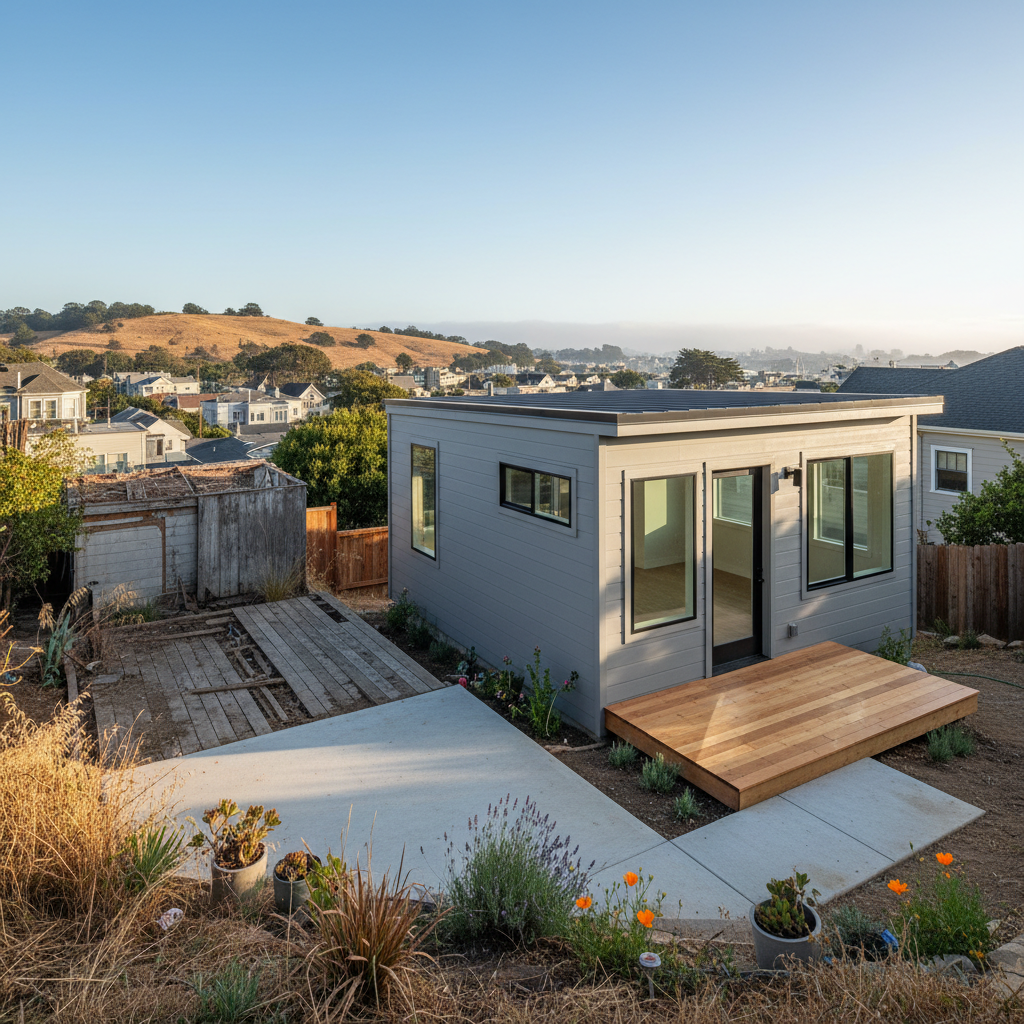
Alright, you're thinking about adding a detached ADU to your backyard. Good call. It's fantastic for extra space, bringing in some rental income, or giving family a place to stay. But once you've settled on 'detached,' the next big question usually pops up: stick-built or modular? This comes up all the time with homeowners right here in San Francisco, and honestly, there's a lot of noise out there. Let's clear the air and talk about what really matters.
What's the Real Difference?
When I talk about 'stick-built,' I mean the good old-fashioned way of putting up a house. We bring all the materials to your site – lumber, nails, insulation, you name it – and we build it from the ground up, piece by piece, right there in your backyard. It's kind of like building with LEGOs, but, you know, way bigger and with more power tools involved.
Modular, on the other hand, is a whole different beast. Picture a house built in a factory, in sections. These sections, or 'modules,' get mostly finished off-site, then they're trucked to your property and craned into place. Once they're set, we connect them, handle the final touches, and hook up all the utilities.
Cost: Not Always What You'd Expect
People often just assume modular is way cheaper. Sometimes it is, sure, but not always, especially in a city like San Francisco. With modular, you do save on some labor costs because factory work tends to be more efficient. But then you've got some serious transportation expenses – getting those huge modules through city streets, navigating hills, and then renting that crane? That's a big ticket item. We're talking about maneuvering a massive piece of building material down a narrow street in the Mission or up a steep grade in Noe Valley. It's not always simple, or cheap.
Stick-built might have higher on-site labor costs, but you skip those massive transport and crane bills. Plus, with stick-built, we can often work around existing landscaping or tight access points much more easily. For a typical detached ADU, you might find the final costs are actually closer than you'd imagine, especially once you factor in all the site prep and utility hookups, which, by the way, both methods require.
Durability and Maintenance: Built to Last
When it comes to how long your ADU will hold up and how much upkeep it'll need, both construction methods can absolutely deliver a quality product. A well-built stick-built ADU, put together by experienced pros like us at Alpha ADU Solutions, is going to be solid. We're talking about standard construction practices that have been proven for centuries. You're getting the same quality of materials and craftsmanship you'd expect in any custom home, no question.
Modular units are also built to code, and they're specifically designed to handle the stress of being transported. So, yeah, they're tough. The real key here isn't the method itself, but the quality of the builder, whether that's the factory or the crew on your site. Don't let anyone tell you one is inherently weaker than the other. It really just comes down to who's doing the work.
Appearance and Customization: Your Vision
This is really where stick-built often shines, especially if you have a very specific vision or a unique backyard situation. With stick-built, we can customize almost anything. Want a particular roofline to match your main house? Need to build around a mature oak tree? Got an odd-shaped lot? Stick-built gives you that kind of flexibility. We can design it to blend in perfectly with your existing property or stand out exactly how you want it to.
Modular units, by their very nature, are more standardized. You'll typically choose from a set of designs and finishes. While there's some customization, it's usually within predefined limits. If you're looking for something truly unique, or if your property has unusual dimensions or challenges, modular can be a tougher fit. Sometimes those factory-built modules just don't quite mesh with the character of an old Victorian neighborhood, you know?
Timeline: Speed Versus Flexibility
Modular construction often brags about a faster overall timeline because a lot of the work happens at the same time – the foundation gets poured while the modules are being built. Once the modules arrive, assembly is much quicker. This can be a big plus if you're on a tight schedule.
Stick-built takes longer on-site. There's no way around that. But it also offers more flexibility during the actual build. If you decide you want to tweak something mid-way through, or if an unforeseen site condition pops up, it's generally easier to adjust with stick-built. With modular, making changes after the factory build starts is difficult, and usually expensive.
My Recommendation for San Francisco Homeowners
Look, both options are perfectly valid ways to get a detached ADU. But for most homeowners here in San Francisco, with our unique lots, often tight access, and a desire for something that truly fits the neighborhood's vibe, I usually lean towards stick-built construction. The flexibility it offers in design and adapting to site conditions often outweighs the potential speed advantage of modular, especially when you consider the logistics and costs of craning modules into a dense urban environment.
You get more control over the final look, and you're not paying a premium for complex transportation and heavy equipment that might just be overkill for your specific project. We can build exactly what you need, right where you need it, without the headaches of trying to shoehorn a factory-built box into a space it wasn't quite designed for.
Ultimately, it really comes down to your specific property, your budget, and what you envision. But if you want a custom, durable ADU that truly belongs in your backyard, stick-built is often the smarter play here in the Bay Area. Give us a shout at Alpha ADU Solutions if you want to talk specifics about your project.